


Research Topics
Development and Study of Human Neuronal Models Derived from iPSCs
One of the fundamental challenges in drug development for human neurological disorders is the translational applicability of research findings. Due to ethical and technical limitations in the use of living human brain tissue, drug development has so far relied primarily on animal studies. While these have provided extremely valuable insights into brain function and the neurobiological basis of these diseases, they have proven less informative with regard to human disease processes.
In the case of Alzheimer’s disease (AD), Parkinson’s disease (PD), frontotemporal dementia (FTD), and amyotrophic lateral sclerosis (ALS), no single animal model fully replicates the spectrum of clinical symptoms observed in humans. For example, many models reproduce only early proteopathy or select pathological features of the disease. Other model systems exhibit a more complex neurodegenerative progression; however, it remains questionable whether they accurately reflect the sequence and range of pathophysiological events occurring in humans.
Consequently, the predictive power of studies conducted in rodent models with respect to drug efficacy falls short of expectations. Given the high failure rate in clinical trials for neurodegenerative and psychiatric disorders, there is an urgent need to develop innovative approaches that can support the creation of more reliable and effective preclinical testing systems.
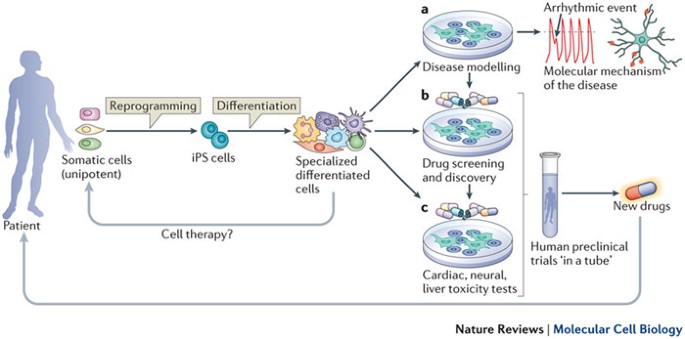 Induced pluripotent stem cell (iPSC) technology, introduced by Yamanaka and Takahashi in 2006, offers a promising solution to this problem. iPSCs are generated in vitro from somatic cells—most commonly derived from skin or blood—by reprogramming them into an embryonic-like pluripotent state. This broad developmental potential enables the generation of human cell types, such as neurons, for therapeutic applications or for the establishment of disease models. In this way, iPSC-based systems allow the investigation of disease mechanisms that cannot be studied directly in patients or adequately modeled in animals.
Such stem cell–based platforms offer several key advantages over traditional animal models:
- They enable the study and characterization of human-specific, disease-relevant cell types, as well as the modeling of early aspects of human brain development;
- They reflect the genetic background of patient populations;
- They can be used for the high-throughput screening of drug candidates.
Our research group is investigating several questions using iPSC-based human neuronal models:
-
Several studies have demonstrated that neurons derived from human iPSCs (h-iPSC-Ns) exhibit a high degree of functional and epigenetic variability. Due to inconsistent characterization and substantial differences among currently available differentiation protocols, it is essential to establish a set of criteria that facilitates standardization and enables the accurate definition and assessment of the developmental properties of iPSC-derived neurons.
In this study, we perform a comprehensive analysis of h-iPSC-Ns using electrophysiological and imaging techniques and track neuronal functional development at both the cellular and network levels. The identified sequence of differentiation stages provides a consistent and robust framework for the design of targeted experiments at distinct phases of neuronal maturation. This framework further enables the application of stage-specific methodologies and the implementation of longitudinal experimental series focusing on the maturation of a single cell culture.-> https://www.biorxiv.org/content/10.1101/2023.09.21.558836v1
-
In vitro model systems used in the preclinical phase of drug development typically consist of cell cultures in which cells reprogrammed from induced pluripotent stem cells—such as neurons in our case—differentiate over a period of weeks. In certain respects, this process resembles the development of mature neurons from neuronal progenitors during embryogenesis. However, cell cultures lack critically important hormonal signals as well as the dynamic physical and chemical cues present in the developing nervous system.
In addition, cell migration and neurite outgrowth in vitro may occur under fundamental physical constraints. The high degree of biophysical variability frequently observed in iPSC-based neuronal cultures is likely attributable, at least in part, to the absence of these external factors and regulatory influences. By modulating neuronal activity, it is possible to promote a more homogeneous developmental trajectory in differentiating neurons.